
Sub-Total: £0.00
Great Irish Famine PowerPoint | P7 & Upper KS2 History
£7.99
Explore the Great Irish Famine (1845–1852), often known internationally as the Irish Potato Famine, with this comprehensive 132-slide P7 / Upper KS2 History PowerPoint.
Beginning with life in Ireland before 1845, pupils investigate potato dependence and blight before exploring Black ’47, hunger and disease, landlords and tenants, public works, soup kitchens, workhouses, evictions, emigration, coffin ships, food exports, the British government’s response and international relief.
The resource also examines the Famine’s lasting impact on Ireland and the Irish diaspora, with discussion questions, historical enquiry, a timeline and end-of-topic quiz.
Ideal for P7, Upper KS2, Fourth Class – Sixth Class, Irish history, migration and local or family-history topics.


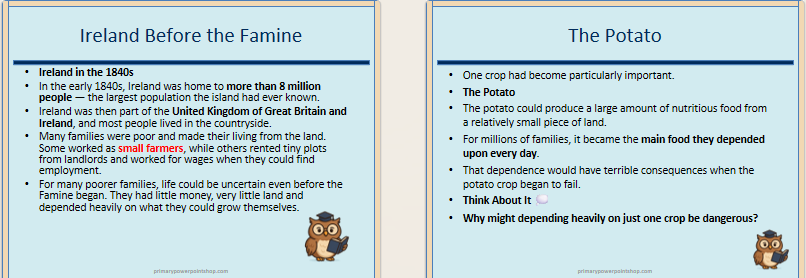
Description
Bring one of the most significant events in Irish history into the classroom with this comprehensive 132-slide Great Irish Famine PowerPoint for P7 and Upper KS2.
Ideal for teaching the Great Irish Famine, Irish Potato Famine, Irish history, Irish immigration and the Irish diaspora in UK, Irish and international classrooms.
Designed to move beyond a simple account of the potato blight, this detailed resource helps pupils investigate why the failure of one crop developed into a devastating famine and how the crisis transformed Ireland and the lives of its people.
The presentation begins by exploring Ireland before the Famine, including population, rural poverty, tenant farming and the extraordinary importance of the potato to poorer families.
Pupils then discover how potato blight arrived in 1845, why the crop failed and why the much more severe failure of 1846 pushed vulnerable communities towards catastrophe.
The Great Famine in Depth
The presentation explores:
- Ireland before the Great Famine
- why the potato was so important
- dependence on a single crop
- the arrival of potato blight
- the crop failures of 1845 and 1846
- how crop failure developed into famine
- poverty and access to food
- landlords and tenant farmers
- rent and eviction
- Black ’47
- hunger and disease
- public works schemes
- the Soup Kitchen Act and emergency food relief
- the Irish workhouse system
- conditions inside workhouses
- evictions during the Famine
- mass emigration
- destinations including Britain, the United States, Canada and Australia
- steerage conditions and the “coffin ships”
- Grosse Île and Irish migration to Canada
- Irish immigration to the United States
- migration to Liverpool, Glasgow and other parts of Britain
- population loss
- food production and food exports
- the British government’s response
- Sir Robert Peel and Lord John Russell
- government policy and the historical debate surrounding responsibility
- Quaker relief
- the Choctaw donation
- American relief and the USS Jamestown
- the Irish diaspora
- the long-term effects on Ireland
- Famine memorials and remembrance
- a Great Famine timeline
- historical causation and interpretation
- an end-of-topic knowledge quiz
More Than Dates and Facts
Throughout the presentation, pupils are encouraged to think like historians.
Rather than presenting potato blight as the only explanation for the catastrophe, pupils consider the interaction between:
potato blight • poverty • dependence on the potato • land ownership • access to food • trade and exports • government policy • relief
They are challenged to evaluate evidence, consider different factors and develop their own supported historical judgements.
Questions such as “Was potato blight alone responsible for the Great Famine?” encourage deeper discussion of historical cause and consequence.
Emigration and the Irish Diaspora
A substantial section examines the extraordinary movement of people caused by the Famine.
Pupils explore journeys to Britain, Canada and the United States, conditions aboard emigrant ships, the quarantine station at Grosse Île and the challenges faced by Irish immigrants as they established new communities overseas.
This makes the resource particularly useful for classrooms outside Ireland where pupils may be exploring Irish migration and ancestry.
Government, Relief and Responsibility
Age-appropriate sections introduce pupils to public works, soup kitchens, workhouses and the policies of the British government.
The presentation also addresses the important fact that other food continued to be produced and exported from Ireland during the Famine, encouraging pupils to consider poverty, purchasing power, trade, government intervention and access to food.
Rather than giving pupils a simplistic explanation, the resource encourages them to consider why historians continue to debate government policy and responsibility.
Remembering the Great Famine
The final sections examine the enormous demographic and social consequences of the Famine and how it is remembered today.
Pupils encounter memorials in Ireland and overseas and consider why societies continue to commemorate traumatic historical events generations later.
A clear 1845–1851 timeline, historical enquiry activity and eight-question knowledge quiz help consolidate learning at the end of the topic.
Suitable For
- P7 History
- Upper KS2 History
- Years 5–6
- Ages approximately 9–11
- The Great Irish Famine
- The Great Famine / Irish Potato Famine
- Irish history
- 19th-century history
- local history
- migration and emigration topics
- Irish immigration to the United States
- Irish immigration to Canada
- Irish migration to Britain
- population and demographic change
- historical cause and consequence
- historical enquiry and interpretation
- citizenship and discussion
- cross-curricular History and Geography
- home education
- UK and Irish classrooms
- US, Canadian and Australian classrooms exploring Irish history and migration
Why Teachers Love This Resource
- 132 comprehensive slides
- Covers the Famine from its background and causes through to its long-term legacy
- Explains why potatoes were so important to poorer families
- Introduces potato blight in accessible language
- Explores Black ’47
- Covers hunger, disease, poverty and eviction sensitively
- Detailed sections on public works, soup kitchens and workhouses
- Explores landlords and tenant farmers without oversimplifying their experiences
- Extensive coverage of emigration and the Irish diaspora
- Includes Britain, the United States and Canada
- Explains “coffin ships” without suggesting every emigrant vessel was one
- Includes Grosse Île
- Examines continuing food production and exports
- Introduces the British government’s response and historical debate
- Includes Peel and Russell
- Explores international assistance, including the Choctaw Nation, Quakers and USS Jamestown
- Encourages historical enquiry rather than simple memorisation
- Develops understanding of cause and consequence
- Includes frequent Think About It discussion questions
- Includes a chronological recap
- Includes a Think Like a Historian enquiry
- Includes an end-of-topic quiz and answers
- Strong visual support throughout
- Suitable for individual lessons or an extended Famine topic
- Ready to teach with minimal preparation
File Type
Microsoft PowerPoint (.pptx)
-
🌍 Explore More KS2 History Resources
If you enjoyed this resource, you may also like our KS2 history worksheets and colouring pages:
- Victorian Family Colouring Sheet KS2 | FREE History Worksheet
- Charles Dickens Diary Entry KS2 | FREE Victorian Writing Activity
- Egyptians Colouring Sheet (FREE Download)
- Romans Colouring Sheet KS2 (FREE Download)
- Vikings Colouring Sheet KS2 (FREE Download)
These free printable colouring pages are perfect for classrooms, homework, or creative time at home.
🎓 Want a Complete KS2 History Lesson?
Save hours of planning with our ready-made KS2 history lesson bundles and PowerPoint lessons:
🏆 Complete Lesson Bundles
- Charles Dickens KS2 Bundle | Complete Literacy & History Unit
- Florence Nightingale KS1 & KS2 Bundle | Lesson & Worksheets
- Romans in Britain KS2 Bundle | 6 Complete History Lessons
- Vikings KS2 Bundle | Complete Viking History Unit
- World War I KS2 Bundle | Complete WW1 History Unit 1914–1918
- Evacuees KS2 Bundle | WWII Cross Curricular Topic Pack
📊 Individual Lessons
- 💥 These engaging lessons are designed for KS1 & KS2 classrooms and require zero preparation — everything you need in one place.
-
🔗 Browse More Resources👉 Browse all of our FREE and premium history resources for KS1 & KS2 here
Related products
-

Who Were the Romans? KS2 PowerPoint History | Romans in Britain Introduction (Lesson 1)
£5.99 Add to basket -
World War I (1914–1918) KS1 & KS2 PowerPoint History Lesson | WW1 Overview
£4.99 Add to basket -
The Great Fire of London KS1 PowerPoint Lesson | History Presentation | Year 1 & Year 2
£4.50 Add to basket -
Roman Life in Britain KS2 PowerPoint | Roman Towns, Homes & Entertainment (Lesson 4)
£4.99 Add to basket

Reviews
There are no reviews yet.