Sub-Total: £0.00
Titanic KS2 PowerPoint | RMS Titanic History Lesson
£7.99
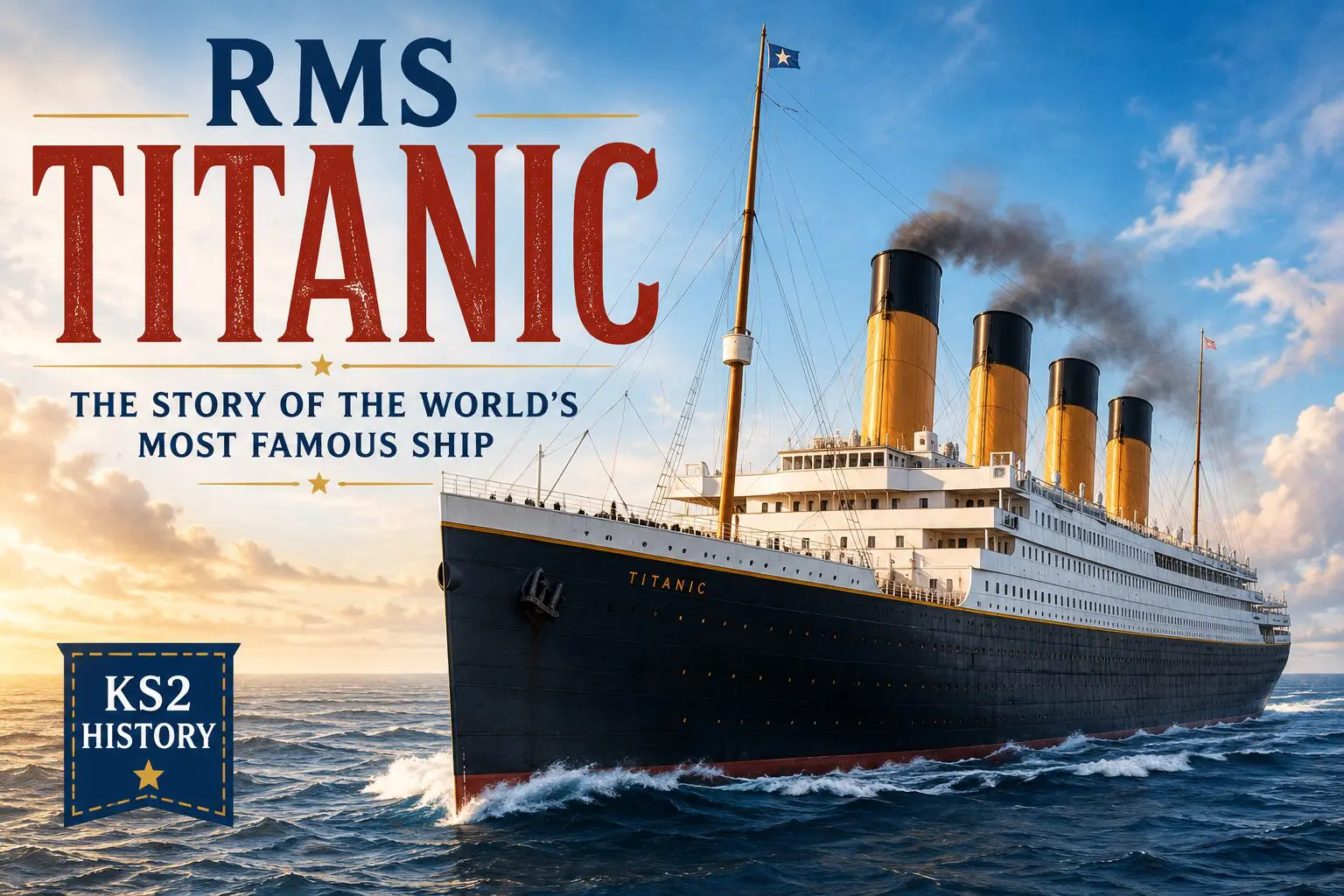
Explore the extraordinary story of RMS Titanic with this comprehensive 130-slide KS2 History PowerPoint. Discover how Titanic was designed and built in Belfast, life aboard the famous ocean liner, her maiden voyage, the iceberg collision and sinking, the rescue of survivors, investigations, changes to safety at sea and the discovery of the wreck in 1985.
Packed with engaging facts, historical detail, discussion questions and striking visuals, this ready-to-use Titanic teaching resource is ideal for KS2 history, transport, ships and significant events topics.


Description
Bring the remarkable story of RMS Titanic to life with this comprehensive 130-slide Titanic KS2 PowerPoint.
Designed as a detailed, ready-to-use teaching resource, this presentation takes pupils from the shipyards of Belfast to the depths of the North Atlantic, exploring not only how Titanic was built and why she sank but also the experiences of the passengers and crew whose lives became part of her story.
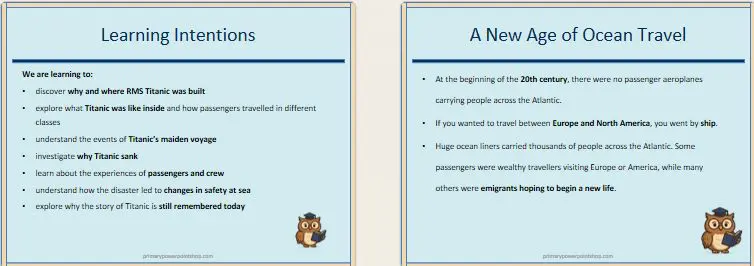
The presentation begins by placing Titanic within the exciting new age of transatlantic ocean travel. Pupils discover the rivalry between the great shipping companies before travelling to Belfast, where Harland & Wolff undertook one of the most ambitious shipbuilding projects of the period.
Children explore Titanic’s construction, launch, fitting out and sea trials before stepping aboard to discover what life was like for First, Second and Third Class passengers. They also learn about the hundreds of crew members whose work kept the enormous ship operating day and night.
The presentation then follows Titanic’s maiden voyage from Southampton to Cherbourg and Queenstown, now Cobh, before heading into the North Atlantic.
As the story develops, pupils examine the ice warnings received on 14 April 1912, the difficult conditions faced by Titanic’s lookouts and the events leading to Frederick Fleet’s famous warning: “Iceberg, right ahead!”
Clear explanations help children understand the damage caused by the collision, Titanic’s watertight compartments and why flooding five or more forward compartments proved catastrophic.
The evacuation and sinking are explored sensitively and appropriately for primary-aged pupils. Children learn about the shortage of lifeboats, the distress calls sent by Jack Phillips and Harold Bride, Carpathia’s race to help, the Titanic musicians, the final lifeboats and the sinking of Titanic during the early hours of 15 April 1912.
The story continues after the ship disappears beneath the Atlantic.
Pupils discover how Carpathia rescued the survivors, how news of the disaster spread around the world, the arrival of survivors in New York and the very different survival rates experienced by passengers and crew.
The resource also encourages pupils to investigate why the disaster happened rather than presenting Titanic’s sinking as the result of one simple cause. Ice warnings, speed, visibility, ship design, lifeboat provision and other circumstances are considered.
Children then explore the investigations that followed and discover how the tragedy contributed to important improvements in maritime safety, including greater lifeboat provision, continuous wireless watches, the International Ice Patrol and international safety rules.
Finally, the presentation jumps forward to the search for Titanic and the discovery of the wreck in 1985 before concluding with a thoughtful reflection on why Titanic and the people aboard her continue to be remembered more than a century later.
Throughout the presentation, carefully placed “Think About It” questions encourage pupils to discuss evidence, consider different perspectives and develop historical thinking.
Topics include:
• the age of transatlantic ocean travel
• the White Star Line and its competitors
• Belfast and Harland & Wolff
• the design and construction of Titanic
• Lord Pirrie and Thomas Andrews
• the Olympic-class liners
• Titanic’s launch in 1911
• fitting out the ship
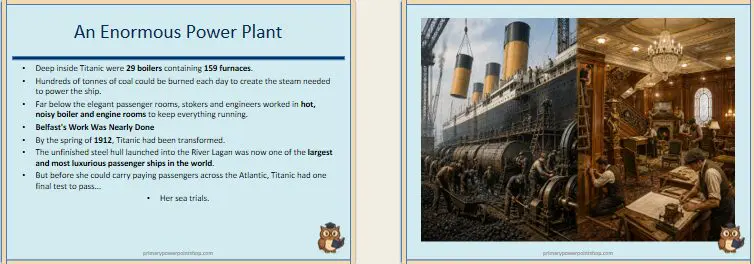
• Titanic’s engines, boilers and machinery
• sea trials
• preparations at Southampton
• Titanic’s passengers and crew
• First Class life and accommodation
• Second Class travel
• Third Class passengers and emigration
• jobs aboard Titanic
• the maiden voyage
• Southampton, Cherbourg and Queenstown
• life aboard during the Atlantic crossing
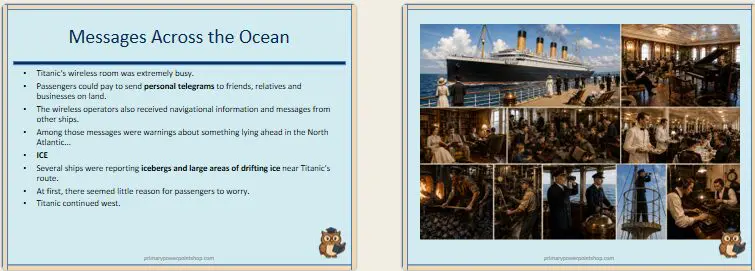
• wireless communication
• iceberg warnings
• the events of 14 April 1912
• “Iceberg, right ahead!”
• the collision and damage
• watertight compartments
• Titanic’s lifeboats
• women and children first
• Titanic’s distress calls
• Carpathia’s response
• Titanic’s musicians
• the final lifeboats
• the sinking at approximately 2:20 am
• survivors waiting for rescue
• Carpathia’s rescue operation
• news of the disaster
• Carpathia’s arrival in New York
• survival rates
• American and British investigations
• possible contributing factors to the disaster
• changes to safety at sea
• the International Ice Patrol
• SOLAS
• the search for Titanic
• the discovery of the wreck in 1985
• Titanic’s lasting legacy
• remembering the passengers and crew
With 130 slides, this resource can be taught as an extended Titanic topic or divided into individual lessons and sections. Teachers can easily select the slides most appropriate for their class and available teaching time.
Suitable for:
• KS2 History
• Upper KS2 topic work
• Titanic history topics
• Local history and Belfast shipbuilding studies
• Transport and ships topics
• Significant historical events
• Cross-curricular history and geography
• Whole-class teaching and discussion
• Home education and independent learning
The presentation is written for UK primary classrooms while also being accessible to international pupils studying RMS Titanic, including learners in the USA, Ireland, Canada and Australia.
Why teachers will love this resource:
✓ An exceptionally comprehensive 130-slide Titanic teaching resource
✓ Follows Titanic’s story chronologically from her construction in Belfast to the discovery of the wreck
✓ Detailed enough to support several lessons rather than a single presentation
✓ Explains complicated topics such as watertight compartments in child-friendly language
✓ Explores the experiences of First, Second and Third Class passengers
✓ Includes the important contribution and experiences of Titanic’s crew
✓ Treats the sinking and loss of life sensitively and appropriately for primary pupils
✓ Encourages historical thinking through regular “Think About It” questions
✓ Explores causes and contributing factors rather than presenting an oversimplified explanation
✓ Shows how lessons learned from Titanic led to improvements in maritime safety
✓ Includes the search for and discovery of Titanic’s wreck
✓ Strong visual presentation designed to maintain pupil interest
✓ Ideal for selecting individual sections or teaching as an extended Titanic topic
✓ Ready to download and use in the classroom
File Type
Microsoft PowerPoint (.pptx) Fully Editable
-
🌍 Explore More KS2 History Resources
If you enjoyed this resource, you may also like our KS2 history worksheets and colouring pages:
- Victorian Family Colouring Sheet KS2 | FREE History Worksheet
- Charles Dickens Diary Entry KS2 | FREE Victorian Writing Activity
- Egyptians Colouring Sheet (FREE Download)
- Romans Colouring Sheet KS2 (FREE Download)
- Vikings Colouring Sheet KS2 (FREE Download)
These free printable colouring pages are perfect for classrooms, homework, or creative time at home.
🎓 Want a Complete KS2 History Lesson?
Save hours of planning with our ready-made KS2 history lesson bundles and PowerPoint lessons:
🏆 Complete Lesson Bundles
- Charles Dickens KS2 Bundle | Complete Literacy & History Unit
- Florence Nightingale KS1 & KS2 Bundle | Lesson & Worksheets
- Romans in Britain KS2 Bundle | 6 Complete History Lessons
- Vikings KS2 Bundle | Complete Viking History Unit
- World War I KS2 Bundle | Complete WW1 History Unit 1914–1918
- Evacuees KS2 Bundle | WWII Cross Curricular Topic Pack
📊 Individual Lessons
- 💥 These engaging lessons are designed for KS1 & KS2 classrooms and require zero preparation — everything you need in one place.🔗 Browse More Resources👉 Browse all of our FREE and premium history resources for KS1 & KS2 here
Related products
-

The Great Fire of London Investigation | KS2 History PowerPoint
£5.99 Add to basket -
The Great Fire of London KS2 Worksheet Pack | Printable History Activities (Years 3–6)
£3.99 Add to basket -
FREE Guy Fawkes Colouring Sheet | KS1 & KS2 Bonfire Night Activity
£0.00 Add to basket -
Knights and Castles KS1 PowerPoint Lesson– Medieval History
£3.50 Add to basket