Sub-Total: £0.00
Explorers Resources for KS1 & KS2 – PowerPoints, Worksheets & Activities

🌍 Amazing Explorer Fact
Did you know that before modern maps and satellites, explorers travelled thousands of miles across unknown oceans, deserts, mountains and jungles using only simple maps, stars and basic navigation tools? Their journeys helped people learn more about the world than ever before.
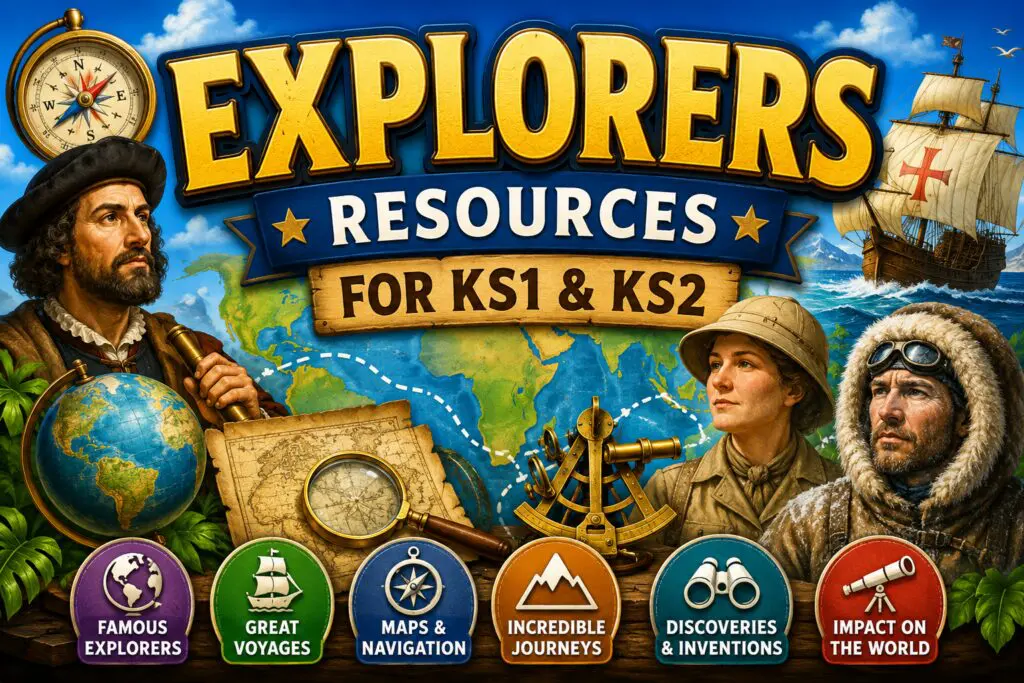
Explorers have shaped our understanding of the world for hundreds of years. From discovering new lands and trade routes to mapping coastlines and studying wildlife, their journeys have changed the way people travel, learn and connect with one another. Our Explorers resources for KS1 and KS2 help children investigate famous expeditions, navigation, maps and the impact explorers have had throughout history.
🧭 What Is an Explorer?
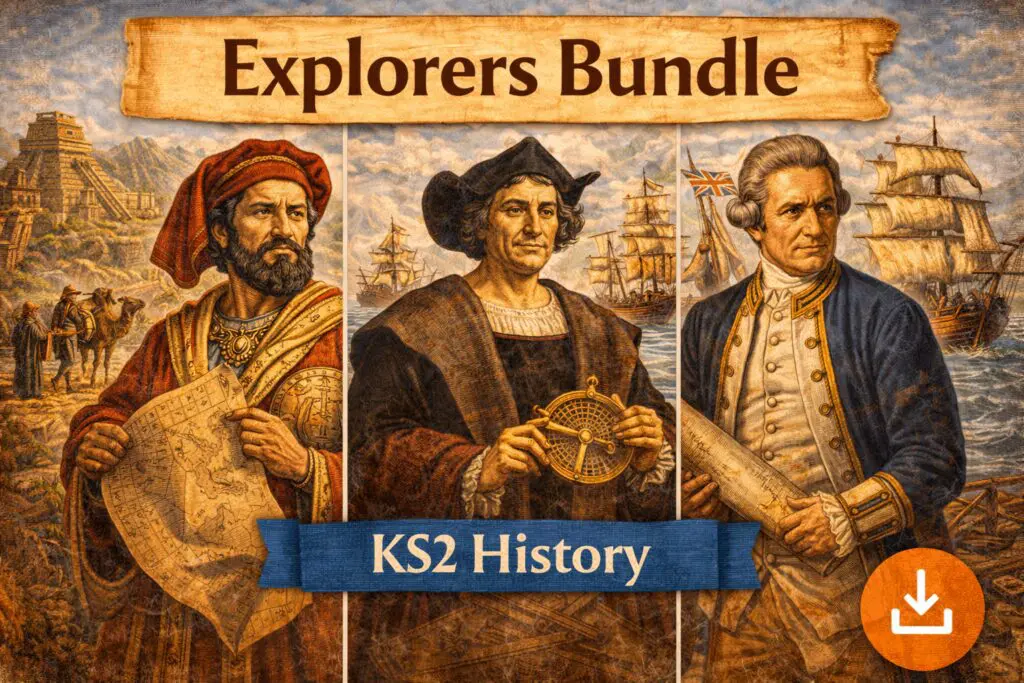
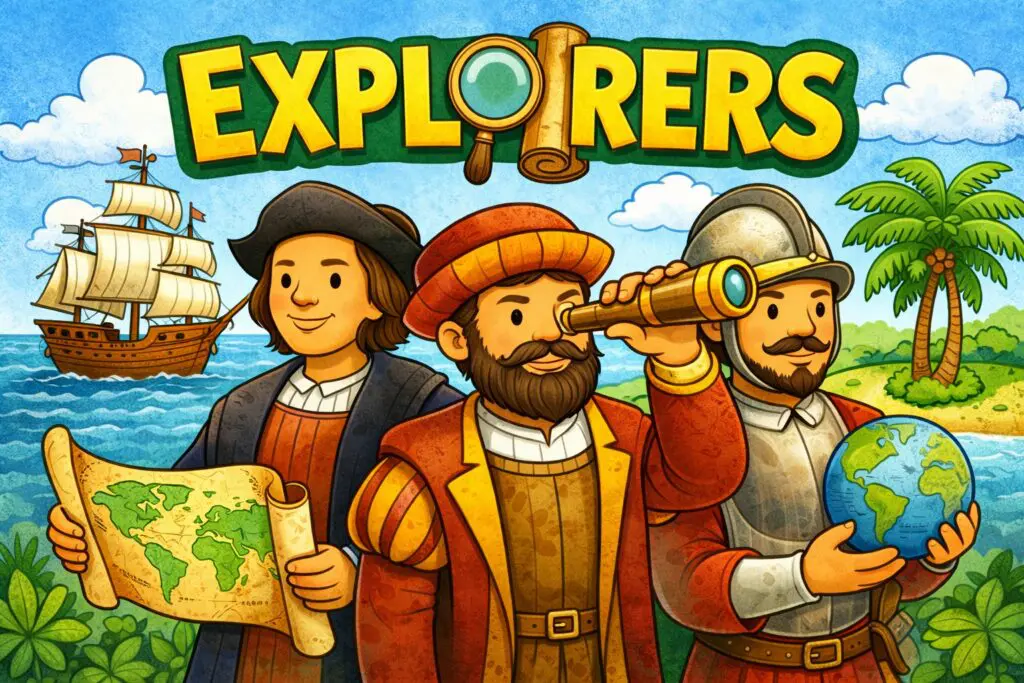
An explorer is a person who travels to new or unfamiliar places to discover, investigate and learn more about the world. Throughout history, explorers have crossed vast oceans, climbed towering mountains, journeyed through deserts and travelled into dense jungles in search of new lands, trade routes and knowledge. Their expeditions helped map the world, introduce different cultures and expand our understanding of geography, plants, animals and people. Today, explorers continue to make exciting discoveries on land, beneath the oceans, in the polar regions and even in outer space.
🌍 Why Did People Explore?
People have explored throughout history for many different reasons. Some explorers searched for new trade routes to buy and sell valuable goods such as spices, silk and gold, while others hoped to discover new lands and claim them for their countries. Many journeys were made to improve maps, study the natural world and learn about different cultures and people. Some explorers were driven by curiosity and adventure, wanting to discover places that no one from their own country had seen before. Their expeditions helped expand our knowledge of the world and changed the way people travelled, traded and understood different parts of the Earth.
🗺️ Maps and Navigation
Maps and navigation have always been essential tools for explorers. Long before modern technology and GPS, explorers relied on paper maps, compasses, the Sun, the Moon and the stars to help them find their way across oceans and unfamiliar lands. Sailors also used instruments such as the astrolabe and sextant to work out their position at sea. As explorers travelled to new places, they carefully recorded what they discovered, allowing maps to become more accurate over time. These improvements helped future explorers travel further, trade with new countries and learn more about the world.
⛵ Christopher Columbus
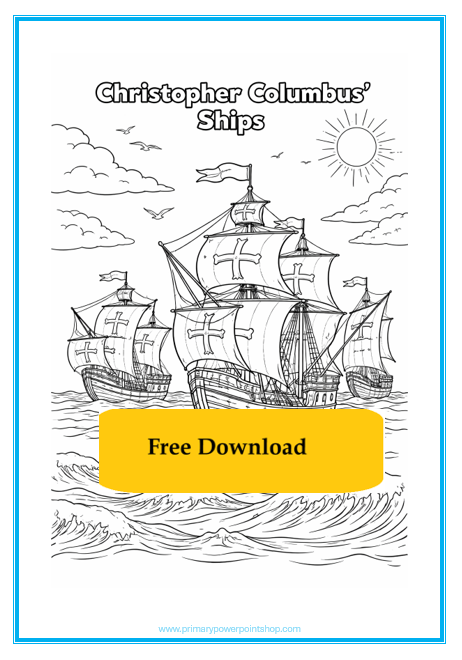
Christopher Columbus was an Italian explorer who sailed across the Atlantic Ocean in 1492 on behalf of Spain. He hoped to find a new sea route to Asia by sailing west but instead reached islands in the Caribbean. Although Columbus believed he had arrived in Asia, his voyages introduced many Europeans to the Americas and marked the beginning of lasting contact between Europe and the American continents. Today, historians recognise that his journeys had a significant impact on world history, while also acknowledging that European exploration brought many hardships and lasting consequences for Indigenous peoples.
🚢 Ferdinand Magellan
Ferdinand Magellan was a Portuguese explorer who led the first expedition to sail around the world. In 1519, he set off with a fleet of five ships on behalf of Spain, hoping to find a western sea route to the Spice Islands. During the voyage, his crew discovered the Strait of Magellan, a narrow passage at the southern tip of South America, before crossing the vast Pacific Ocean. Although Magellan was killed in the Philippines in 1521, one of his ships completed the journey back to Spain, proving for the first time that the Earth could be circumnavigated by sea. His expedition greatly improved maps and expanded Europe’s understanding of the world’s oceans.
🧭 Sir Francis Drake
Sir Francis Drake was an English explorer, sea captain and navigator who became famous for sailing around the world between 1577 and 1580. He was the first Englishman to successfully complete a circumnavigation of the globe, proving that long-distance sea voyages were possible. Drake explored new coastlines, improved maps and helped England become a powerful seafaring nation. He is also remembered for defeating the Spanish Armada in 1588, making him one of the most famous explorers and naval leaders in British history.
❄️ Captain James Cook
Captain James Cook was a British explorer, navigator and cartographer who made three famous voyages across the Pacific Ocean during the 1700s. He carefully mapped the coastlines of New Zealand, Australia and many Pacific islands, greatly improving the world’s maps. In 1770, Cook became the first recorded European to chart the east coast of Australia, where he claimed the land for Britain. His expeditions also helped scientists learn more about geography, plants, animals and the peoples of the Pacific. Although his voyages expanded knowledge of the world, they also marked the beginning of major changes for many Indigenous communities.
🏔️ Ernest Shackleton
Ernest Shackleton was an Irish-born explorer who became famous for leading British expeditions to Antarctica in the early 1900s. In 1914, he set out to become the first person to cross the Antarctic continent, but his ship, Endurance, became trapped and crushed by thick ice. Although the expedition could not continue, Shackleton showed remarkable bravery and leadership by guiding all 27 members of his crew to safety after months of surviving on the frozen ice and making a dangerous journey across the Southern Ocean. Today, he is remembered as one of history’s greatest explorers because of his determination, resilience and outstanding leadership in the face of extreme challenges.
🌿 David Livingstone
David Livingstone was a Scottish explorer, doctor and missionary who travelled extensively across Africa during the 1800s. He explored regions that were largely unknown to Europeans at the time, mapping rivers, lakes and landscapes while studying the people, wildlife and environment. Livingstone is especially famous for his exploration of the Zambezi River and for introducing Victoria Falls to the wider world in 1855, naming the waterfall after Queen Victoria. He also spoke out against the East African slave trade, believing it should be ended. His journeys helped increase geographical knowledge of Africa and inspired future explorers, although historians also recognise that European exploration had lasting effects on the people and cultures of the continent.
🦍 Dian Fossey
Dian Fossey was an American zoologist and conservationist who dedicated her life to studying and protecting mountain gorillas in the forests of Rwanda. Beginning in the 1960s, she spent many years observing gorillas in their natural habitat, helping scientists learn about their behaviour, family groups and way of life. Fossey worked tirelessly to protect gorillas from poaching and habitat loss, raising awareness of the threats they faced. Her research played a vital role in gorilla conservation, and her work continues to inspire wildlife scientists and conservationists around the world today.
🌎 How Exploration Changed the World
Exploration changed the world by helping people learn more about different countries, cultures and environments. As explorers travelled to new places, they created more accurate maps, discovered new trade routes and shared ideas, foods and inventions between different parts of the world. Their journeys led to advances in science, geography and navigation, making travel and communication easier. However, exploration also had negative consequences. In many places, Indigenous peoples lost their land, cultures and ways of life as European countries claimed new territories. Today, historians study exploration by considering both the important discoveries that were made and the lasting impact these journeys had on people around the world.
⭐ Fun Facts About Explorers
🌍 Christopher Columbus crossed the Atlantic Ocean in 1492, hoping to find a new route to Asia, but instead reached the Caribbean.
🚢 Ferdinand Magellan’s expedition was the first to sail all the way around the world, proving that the Earth could be circumnavigated by sea.
⚓ Sir Francis Drake became the first Englishman to sail around the world.
🦘 Captain James Cook produced some of the most accurate maps of Australia, New Zealand and the Pacific during the 1700s.
❄️ Ernest Shackleton’s entire crew survived after their ship, Endurance, was crushed by Antarctic ice—a remarkable story of leadership and survival.
🌊 Before GPS, explorers used compasses, maps, the Sun and the stars to find their way.
🗺️ Early explorers often had to create their own maps because many places had never been accurately recorded.
🦍 Dian Fossey helped protect endangered mountain gorillas and changed the way people understood these amazing animals.
🌎 Exploration has helped us learn about every continent on Earth, from the frozen landscapes of Antarctica to the deepest rainforests.
🚀 Exploration continues today, with scientists and astronauts discovering new things beneath the oceans, in remote environments and even in outer space.
💬 Discussion Questions
What qualities do you think make a good explorer?
Why did people risk dangerous journeys to explore new places?
How did maps and navigation help explorers travel around the world?
Which explorer do you think made the greatest contribution to history? Why?
What challenges do you think explorers faced during their expeditions?
How has exploration changed our understanding of the world?
What are some of the positive and negative effects of exploration on different people and cultures?
How is modern exploration different from the journeys made hundreds of years ago?
If you could explore anywhere in the world—or even beyond Earth—where would you go and what would you hope to discover?
Why is exploration still important today, even though most of the world has already been mapped?
❤️ Why Learn About Explorers?
Learning about explorers helps children understand how our knowledge of the world has grown over time. By studying famous explorers and their incredible journeys, pupils discover how new lands were mapped, trade routes were established and different cultures came into contact with one another. They also learn about the skills explorers needed, including courage, resilience, teamwork and problem-solving. Exploring this topic encourages children to think about both the achievements of exploration and its impact on Indigenous peoples and communities, helping them develop a balanced understanding of history and the world we live in today.
📜 Explorer Timeline
1271 – Marco Polo begins his famous journey from Europe to China, sharing stories that inspire future explorers.
1492 – Christopher Columbus sails across the Atlantic Ocean and reaches the Caribbean.
1497 – John Cabot explores the east coast of North America on behalf of England.
1519–1522 – Ferdinand Magellan’s expedition becomes the first to sail all the way around the world.
1577–1580 – Sir Francis Drake becomes the first Englishman to circumnavigate the globe.
1768–1779 – Captain James Cook explores and maps New Zealand, Australia and many Pacific islands.
1855 – David Livingstone introduces Victoria Falls to the wider world during his exploration of Africa.
1901–1904 – Robert Falcon Scott leads his first Antarctic expedition, helping scientists learn more about the frozen continent.
1914–1917 – Ernest Shackleton’s Endurance Expedition becomes one of history’s greatest survival stories after his ship is trapped in Antarctic ice.
1967 onwards – Dian Fossey begins studying and protecting mountain gorillas in Rwanda, helping to inspire modern wildlife conservation.
Today and Beyond – Explorers continue to make exciting discoveries beneath the oceans, in remote rainforests, at the North and South Poles and in outer space.
📚 Related Resources